The most dangerous words in finance are 'that's how we've always done it.' The CFO's job is to make sure those words never calcify into culture.
— Luca Maestri, CFO, Apple — CFO Leadership Summit, 2021
A mental model is a cognitive framework through which we interpret and interact with the world. Charlie Munger, the legendary investor and Vice Chairman of Berkshire Hathaway, spent decades arguing that the quality of one's collection of mental models is the primary determinant of the quality of one's decisions. 'You've got to have models in your head,' Munger wrote, 'and you've got to array your experience, both vicarious and direct, on this latticework of models.'
For the CFO, this insight is particularly powerful. The finance function generates more information, more signals, more data than perhaps any other organizational unit. The quality of what the CFO makes of all that information — the insights they extract, the decisions they shape, the risks they surface, the opportunities they recognize — is directly determined by the quality of the mental models through which they process it.
In this chapter, we examine seven mental models that define the mindset of the world-class CFO. These are not financial formulas or accounting standards. They are frameworks for thinking — ways of seeing the world that consistently produce superior financial leadership.

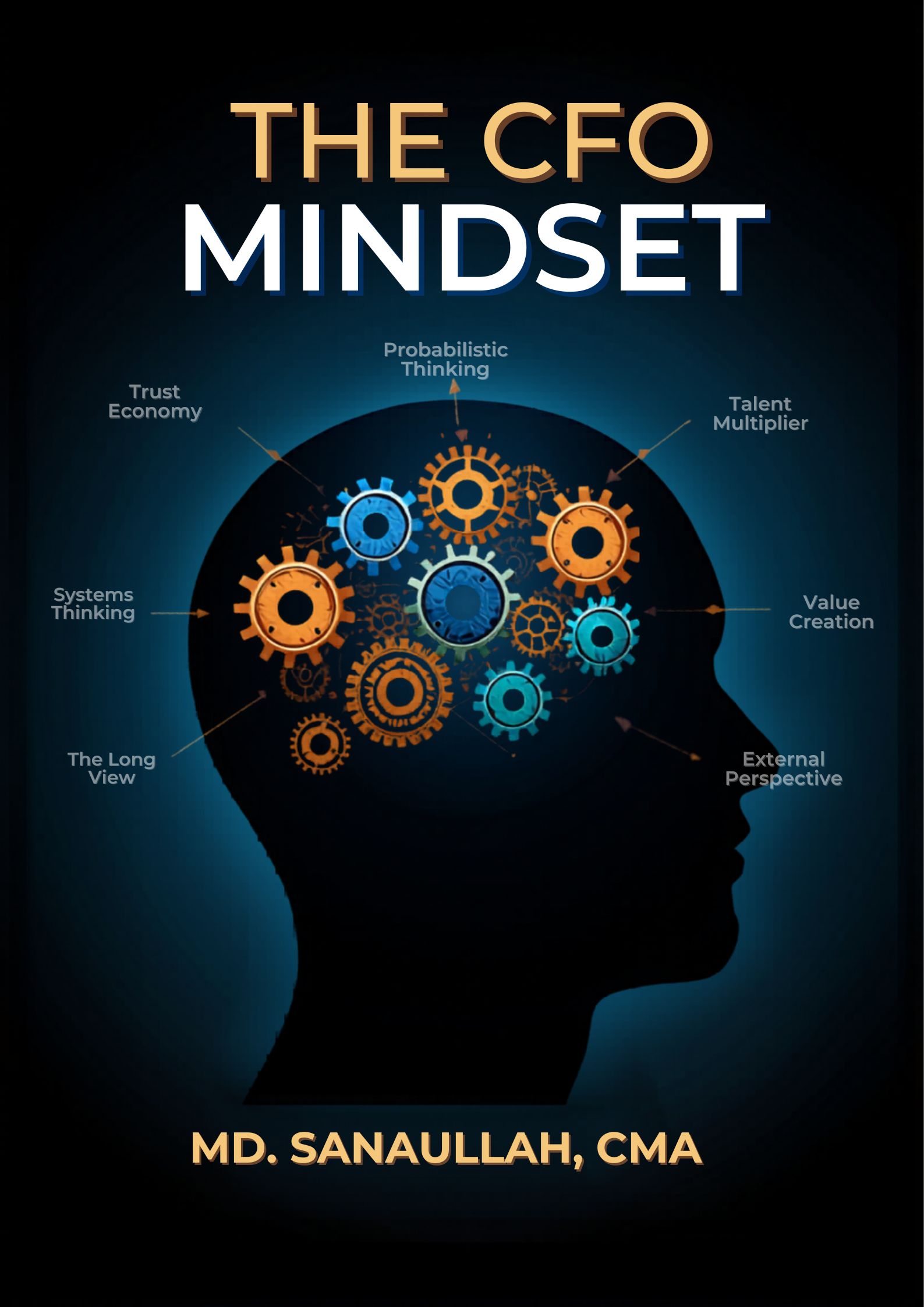
THE CFO MINDSET BY MD SANAULLAH, CMA
1: The Value Creation Lens
2: Systems Thinking
3: Probabilistic Thinking
4: The Long View
5: The Trust Economy
6: The Talent Multiplier
7: The External Perspective
The CFO Mindset is built on seven foundational mental models: the Value Creation Lens, Systems Thinking, Probabilistic Thinking, the Long View, the Trust Economy, the Talent Multiplier, and the External Perspective. These models do not replace technical competence — they amplify it, directing technical capability toward the highest-value applications and ensuring that financial analysis produces wisdom rather than merely information.
Building these mental models is a deliberate practice. It requires reading beyond finance, seeking feedback on your own thinking, and regularly testing your mental models against reality. The chapters that follow explore how these mental models express themselves in the specific domains of the CFO's work.
👉 Premium Finance Courses:
https://ibsedu.co/all-courses.php
🎥 Free Finance Lessons (Subscribe on YouTube):
https://www.youtube.com/@IndianBusinessSchool1
Leave an Opinion
Categories




No posts available in this category.
No posts available in this category.






Recent Opinions :
No Opinion yet. Be the first one!