
👉 Premium Finance Courses: https://ibsedu.co/all-courses.php
“He doesn’t know what’s going on.”**
It sounds unfair.
It sounds harsh.
It sounds uncomfortable.
But this is the unwritten truth of the CFO–CEO dynamic — and honestly, it happens across every manager–employee relationship too.
And global research from HBR, McKinsey, Wharton, INSEAD confirms it.
THE ARTICLE
Most CFOs are brilliant.
Most work harder than anyone else.
Most understand the business at a deeper level than the CEO.
Yet… many still lose credibility in the moment that matters most.
Why?
Because when the pressure is high — boardroom presentations, CEO meetings, investor calls — many finance leaders default to the same pattern:
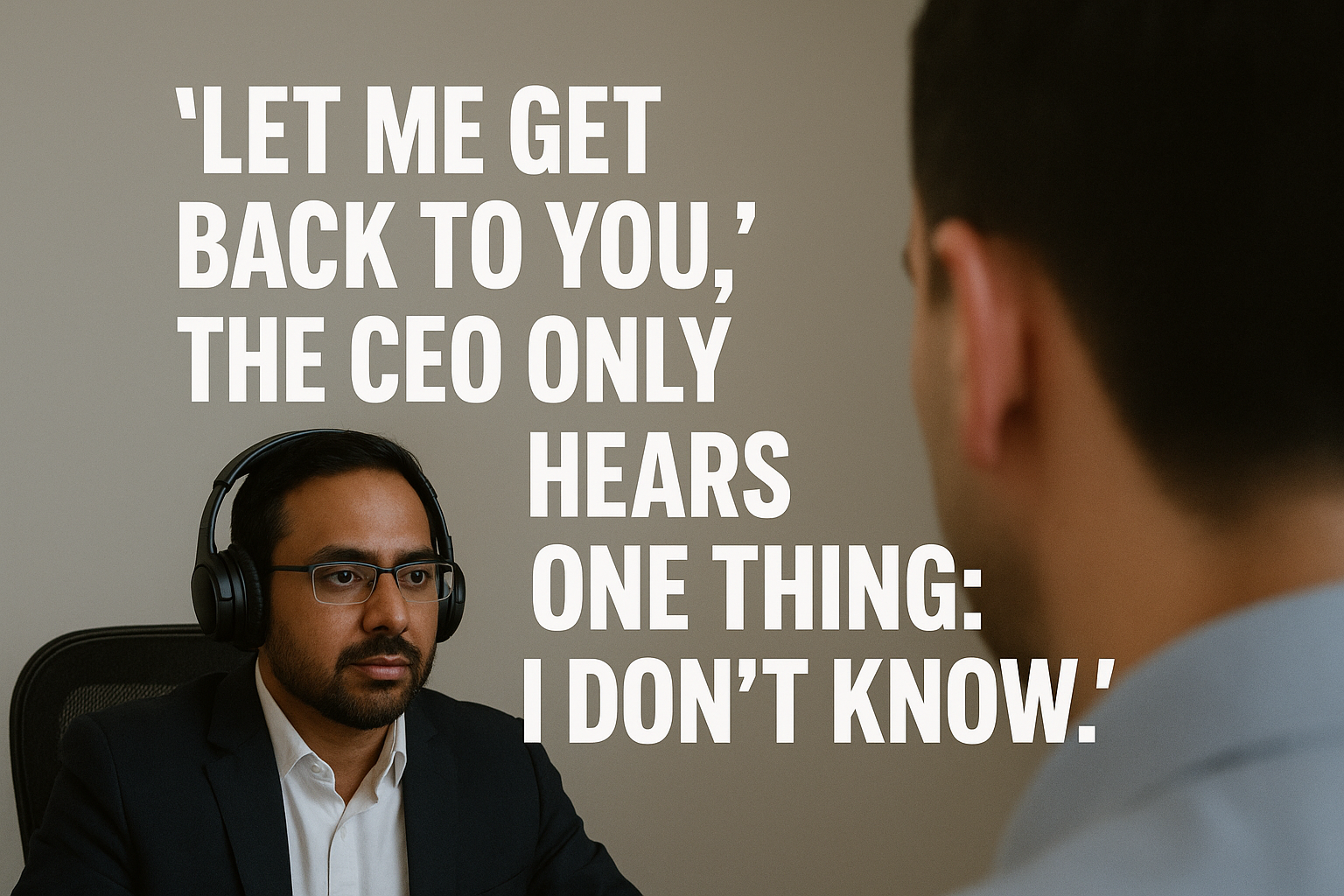
➡️ “Let me check and get back to you.”
➡️ “I’ll confirm after the meeting.”
➡️ “I don’t have that number right now.”
Technically justified.
Factually correct.
Logically reasonable.
But perception kills the credibility instantly.
Here’s the uncomfortable reality:
When a CFO says “I’ll get back to you,”
the CEO doesn’t hear diligence.
They hear:
“He doesn’t know.”
“He wasn’t prepared.”
“He’s not in control of the numbers.”
And this isn’t just CFO–CEO.
This happens between:
✔ Managers and team members
✔ Directors and VPs
✔ Founders and department heads
The rule is universal:
In leadership, hesitation is interpreted as confusion.
Thousands of numbers.
Ever-changing KPIs.
Moving forecasts.
Shifting assumptions.
Daily surprises.
No one — not even the best CFO — can carry everything in their head.
So how do elite CFOs handle this paradox?
McKinsey’s research shows:
The #1 expectation CEOs have from CFOs is: No surprises.
Top CFOs walk in knowing:
• Unusual variances
• Revenue dips
• Cost spikes
• Cash pressure
• Delayed collections
• Margin compression
• Any risk to the quarter
It’s not memory.
It’s anticipation.
Wharton calls this the Premortem Method.
Elite CFOs list out the 10–15 most predictable questions before entering the room.
Then they prepare crisp, strategic answers.
This is why they seem to “know everything instantly.”
They give directional truth:
“Directionally, margins compress by ~100 bps due to labor cost. I’ll validate exacts after the meeting.”
“Trend is clear — I’ll confirm the absolute figure by EOD.”
Leadership = clarity + caution
Not guessing numbers.
INSEAD’s CEO–CFO study shows CEOs trust CFOs who can:
• Simplify complexity
• Remove noise
• Tell the business story
• Provide solutions, not spreadsheets
CFO leadership is not about decimals.
It’s about narrative control.
The problem is NOT “Let me get back to you.”
The problem is how you say it.
❌ Weak: “I don’t know.”
❌ Weak: “Let me check.”
✔️ Strong:
“Directionally this is the impact — I’ll validate exact assumptions after the meeting.”
That’s the language of a strategic CFO.
In the modern boardroom, you’re not valued for memorizing numbers.
You’re valued for commanding the narrative with clarity, anticipation, and confidence.
Because the CFO who always says
“Let me get back to you”
loses the room.
But the CFO who says
“Here’s the direction — I’ll confirm exacts shortly.”
earns trust, influence, and strategic power.
Maste Financial Modelling, Financial Reporting, FP&A, Budgeting, Costing, Accounting, Strategy & more:
👉 Premium Finance Courses:
https://ibsedu.co/all-courses.php
🎥 Free Finance Lessons (Subscribe on YouTube):
https://www.youtube.com/@IndianBusinessSchool1
🔴 THE PSYCHOLOGY BEHIND IT
🌍 THE PARADOX: Finance Is Too Complex to Answer Everything Instantly
⚡ 1. They Anticipate the Questions Before the Room Starts
⚡ 2. They Prepare a “Question Map” Before Every Meeting
⚡ 3. They Never Guess… But They Never Say “I Don’t Know” Either
⚡ 4. CEOs DO Understand Complexity — They Just Expect Translation
🌟 BOTTOM LINE
🎓 Want to Think, Speak & Lead Like a Strategic CFO?
Leave an Opinion
Categories




No posts available in this category.
No posts available in this category.






Recent Opinions :
No Opinion yet. Be the first one!